

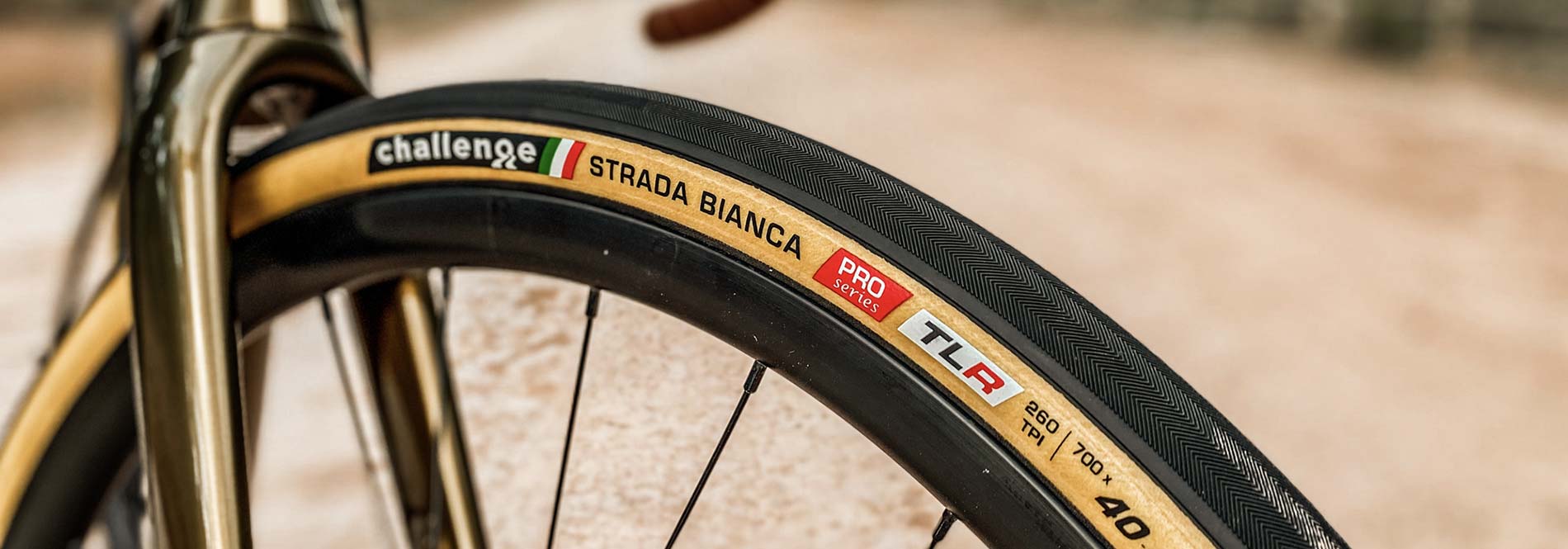
Find answers to common questions about Challenge handmade bicycle tires, tubeless setup, tubular installation, tire pressure, storage, and troubleshooting.
This FAQ covers road, gravel, and cyclocross tire setup and maintenance.
About Challenge Handmade Tires
ABOUT CHALLENGE TIRES
What makes Challenge tires different from other bicycle tires?
Challenge tires are designed for riders who want more grip, comfort, and speed from a high-performance casing and tread construction. Our handmade tires use flexible, high-thread-count casings and natural rubber compounds to improve ride feel, traction, and rolling efficiency.
If handmade tires perform better, why does Challenge still offer vulcanized tires?
Challenge offers vulcanized tires to provide more affordable and durable options for riders who prioritize longevity, value, or heavy-duty use. While handmade tires deliver maximum performance and ride quality, vulcanized tires remain an excellent option for riders who need increased durability, lower cost, or reliable performance in demanding conditions.
What are the different Challenge tire series?
RACE (vulcanized), PRO, XP, TE (Team Edition), and ULTRA — each with different casing materials and performance levels.
TIRE TYPES
What is a handmade bicycle tire?
A handmade bicycle tire is built using more flexible materials and construction methods than a standard mass-produced vulcanized tire. This allows the tire to better conform to the ground for improved grip, comfort, and lower rolling resistance.
What's the difference between handmade and vulcanized bicycle tires?
Handmade bicycle tires use flexible fabric casings and natural rubber components assembled without heat-based vulcanization, while vulcanized tires use heat-molded synthetic rubber and stiffer casing materials.
Vulcanized tires are produced by dipping nylon casing material into butyl rubber and compressing it between rollers to create a reinforced casing. These casings typically use lower thread counts (often up to about 60 TPI), leaving larger gaps filled with stiff rubber. The tread and casing are then molded under heat to form the final tire.
Handmade tires are built using high-quality fabric casings such as cotton, polyester, or silk. These casings are coated using latex or natural adhesives and assembled step-by-step by skilled craftspeople. The tread is applied using natural rubber compounds without the heat-hardening process used in vulcanization.
This construction preserves casing flexibility, resulting in improved grip, comfort, and ride feel compared to traditional vulcanized construction.
Handmade tire construction also relies more heavily on natural materials and adhesives, making it less dependent on petroleum-based rubber than traditional vulcanized tire manufacturing.
Why does casing flexibility matter in tire performance?
A more flexible casing allows the tire to better follow the surface beneath it. That improves traction, smooths vibration, and can reduce rolling resistance compared to a stiffer casing.
Are handmade tires more comfortable?
Yes. Handmade tires are typically more comfortable because the casing is more flexible and absorbs more road or trail vibration than a stiffer tire construction.
Are handmade bicycle tires less durable than vulcanized tires?
Handmade tires are typically slightly less durable than vulcanized tires, but they offer improved ride quality, traction, and performance.
Because handmade tires use softer natural rubber compounds that are not heat-hardened, the tread remains more flexible and responsive. This improves traction and ride feel but may result in faster tread wear compared to harder vulcanized rubber compounds.
For many riders, this will translate to perhaps a 20% reduction in tread lifespan depending on terrain, riding style, and maintenance habits.
Many riders choose handmade tires specifically because the performance benefits outweigh the modest reduction in durability.
What is a tubular tire?
A tubular tire is a tire that is fully enclosed and bonded directly to a compatible tubular rim using adhesive.
Unlike clincher or tubeless-ready tires, tubular tires do not rely on bead hooks to stay attached to the rim.
What is a tubeless tubular (TLTU) tire?
A Tubeless Tubular (TLTU) is a distinct tire type that combines the performance characteristics of a tubular with the puncture protection benefits of a tubeless system.
It is a specialized bicycle tire combining tubular construction where the casing is sewn around an inner tube with modern tubeless, sealant-compatible technology for enhanced puncture resistance and reliability. Commonly used in professional gravel and cyclocross, they offer the security of a tubed system with fewer pinch flats.
CHOOSING THE RIGHT TIRE
How do I choose the right Challenge tire?
Choosing the right Challenge tire depends on your riding discipline, terrain, rider weight, and performance priorities.
Start by identifying the type of riding you do most often, such as road, gravel, cyclocross, or mixed-surface riding. From there, consider the terrain conditions. Smooth pavement, rough gravel, mud, or loose dirt all require different tread patterns and casing constructions.
Riders seeking maximum performance and ride quality often prefer handmade tires due to their supple casing and improved traction. Riders prioritizing durability or cost may prefer vulcanized tires.
If you're unsure, selecting a tire designed specifically for your discipline and typical terrain is the best starting point.
How do I select a Challenge road tire?
Challenge offers four road tire models: Criterium RS, Strada, 4 Stagioni, and Elite. Each tire is suited to different riding styles, conditions, and budgets. All Challenge road tires are handmade, meaning they use high-quality casing materials assembled by skilled craftspeople without industrial vulcanization. The right tire depends on your priorities: maximum performance, all-conditions reliability, everyday durability, or value.
How do I select a Challenge cyclocross tire?
Challenge offers six cyclocross tire models: Koksijde, Dune, Chicane, Grifo, Flandrien, Baby Limus, and Limus. Each tire is designed to perform across a specific range of course conditions, from dry sand and hardpack to deep mud and extreme terrain. Cyclocross tire selection is highly condition-dependent, with the right choice influenced by course surface, weather, and riding style. All Challenge cyclocross tires are handmade and available in multiple series (PRO, TE, and ULTRA) to match different performance levels and budgets.
How do I select a Challenge gravel tire?
Challenge offers six gravel tire models: Strada Bianca, Getaway, Getaway XP, Gravel Grinder, Gravine, and Gravine XP. Each tire is designed for a specific range of terrain and conditions, from smooth hardpack and fast dirt roads to loose gravel, rocks, roots, soft soil, and mud. Gravel tire selection is primarily terrain- and condition-dependent, with key factors including rolling resistance, surface type, and the level of puncture protection required. All Challenge gravel tires are handmade and available in PRO and XP Series to match different performance and durability needs.
INSTALLATION & MOUNTING
Are Challenge Tires Hard to Mount?
Challenge tires are built with tight tolerances for a secure, performance-oriented fit. This can improve safety, air retention, and tubeless performance, but it also means careful mounting technique is important.
How do I mount a Challenge clincher tire?
Start by installing one bead fully onto the rim, then work the second bead on while keeping the mounted portion pushed into the rim’s center channel. Finish at the valve and avoid pinching the tube if you are using one.
How do I mount a Challenge tubeless tire?
Install the tire so both beads sit as deeply as possible in the rim channel, then use a tubeless inflator or compressor if needed to seat the tire. Once seated, add sealant if it was not added first, inflate to seating pressure, and check that the bead is fully and evenly locked into place.
Can I use tire levers to install Challenge tires?
Yes, but only carefully and only if needed. Proper technique should always come first, and tire levers should be used cautiously to avoid damaging the tire bead, rim, or tube.
Are Challenge tires tubeless compatible?
Many Challenge tires are tubeless-compatible, but compatibility depends on the specific tire model.
Always confirm tubeless compatibility by checking the tire sidewall markings or the product page before installation.
Why won't my tubeless tire seat?
A tubeless tire may not seat properly if airflow is insufficient or if the tire bead is not positioned correctly.
Common causes include:
- Rim tape leaks
- Improper valve installation
- Beads not fully in the rim channel
- Insufficient airflow during inflation
Verify rim tape coverage, valve installation, and bead position before inflating again.
What are the advantages of tubular tires compared to tubeless-ready tires?
Tubular tires offer several performance advantages.
These advantages include:
- Lower overall wheel and tire system weight
- Faster acceleration and climbing response
- Reduced risk of bead-related failures
- Improved comfort on rough terrain
- Ability to maintain control after significant air loss
- Simplified replacement during racing situations
Are Challenge TLR tires compatible with hookless (TSS) rims?
Hookless rim compatibility depends on the specific tire model and size. Not all Challenge TLR tires are approved for use on hookless (TSS) rims.
The following guidelines apply:
- Challenge Handmade (PRO, TE, and XP Series) TLR tires in sizes 33C–45C are approved for use on hookless rims.
- All sizes of the Criterium RS TLR are hookless compatible.
- RACE Series TLR tires are not approved for hookless rims, with one exception: the Getaway RACE Series TLR is hookless compatible.
Using a tire on an incompatible rim type can result in dangerous bead failure at speed. Always verify compatibility before mounting, and follow the maximum tire pressure guidelines specified for hookless rim systems.
For full ETRTO guidelines and rim compatibility details, visit our Tubeless Compatibility page.
TIRE PRESSURE & SETUP
What tire pressure should I run in Challenge tires?
Correct tire pressure depends on rider weight, tire size, terrain, and rim width.
Start within the recommended pressure range printed on the tire sidewall and adjust gradually based on ride feel, traction, and comfort.
Lower pressures improve grip and comfort, while higher pressures improve rolling efficiency and reduce the risk of impacts.
Can I run lower pressures with handmade tires?
Often, yes.
Flexible casing materials allow handmade tires to perform well at lower pressures, improving comfort and traction. However, pressure must still remain high enough to protect rims and maintain stability.
What does TPI mean in bicycle tires?
TPI stands for threads per inch. It refers to the density of the casing fabric used in the tire. Higher-quality, higher-thread-count casings are generally more supple and can improve ride feel and performance.
CARE & STORAGE
How should I care for and store Challenge handmade tires?
Challenge handmade tires are made with the highest quality natural materials and processes and benefit from proper care and storage.
Cleaning
Clean handmade tires using a soft brush and mild soap. Rinse thoroughly and allow the tire to dry completely before storing. Avoid high-pressure water directed at the casing, stiff brushes, and any cleaning agents containing degreasers, as these can damage sidewall coatings.
Storage
Store tires in a cool, dry area away from direct sunlight. Prolonged UV exposure will degrade the natural rubber compounds in both the tread and casing, reducing tire lifespan.
Storing tubular tires
Tubular tires require additional care due to the nature of the handmade construction and the adhesives used in production.
- Unpack and inflate tubular tires immediately upon receipt. Air freight packaging requires tires to be folded flat. Leaving a tubular folded for an extended period can affect the integrity of the glue bond and may cause the latex inner tube to stick to itself, which can affect roundness and ride quality.
- Inflate to approximately 20 psi / 1.4 bar after unpacking and store in a round, inflated state.
- Do not store tubular tires folded or hanging from hooks or bars. Both methods can cause fold-related damage at the tread-casing junction.
- Do not remove tubular tires from their individual protective bags until you are ready to install them.
- Store in a dark, dry environment. Humidity can inhibit glue curing and promote mold growth in cotton or silk casings.